


Fluid flow in the fascia & how it is affected by treatment & vibrations
Recently, a German researcher showed that the connective tissue in a human transports 15 l of water in 48 hours, which is a relatively large amount compared to for example the amount of blood and the lymphatic system.
- 01Use vibration therapy to increase fluid flow in fascia by up to 12 times
- 02Fascia transports 15 litres of water every 48 hours — keep it hydrated and mobile
- 03Vary your movement daily to stimulate the 6x more neurons in fascia than in muscle
- 04Manual therapy works primarily by moving water through tissue, not reshaping it
- 05Match vibration frequency deliberately — the range determines how much fluid moves
Fluid flow in the fascia & how it is affected by treatment & vibrations
It has been found that in the connective tissue there are six times more neurons than in for example muscles. There are neurons for both pain reception and position determination. These neurons are affected by vibrations and varied movement. (1)
Recently, a German researcher showed that the connective tissue in a human transports 15 l of water in 48 hours, which is a relatively large amount compared to for example the amount of blood and the lymphatic system. (2)
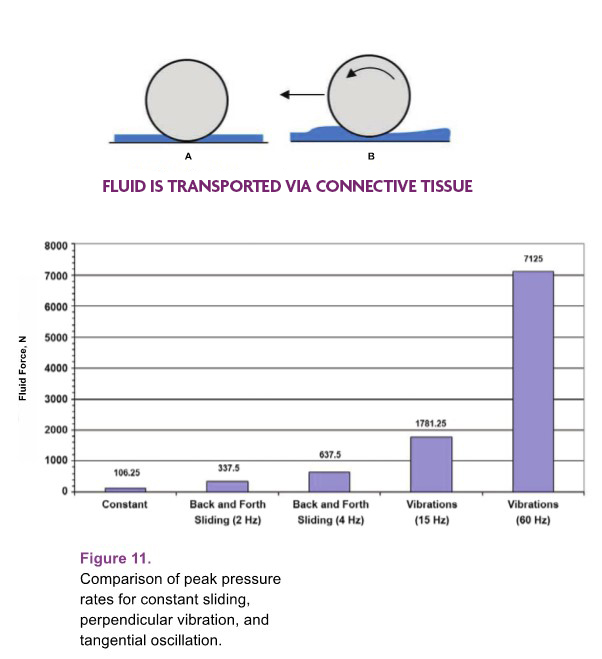
There are several studies showing that manual therapy largely involves the movement of water in tissue. In many trials, it has been shown that in manual therapy it is not about tissue processing, but about increasing the flow of water in the tissue. (3, 4). The same report shows that by using static vibration we can increase the flow of fluid in the tissue from 3-12 times depending on the frequency.
Sources
_(1) Fascial plasticity – a new neurobiological explanation- Part 1 (Shleip 2002), (2) Looking in particular at flow of fluid through that tissue (Reed 2011), (3) Mathematical Analysis of the Flow of Hyaluronic Acid Around Fascia During (Roma et al 2013), (4) A theoretical framework for the role of fascia in manual therapy (Simmonds et al 2010)_
- _By Axel Bohlin Founder & Editor, The Fascia Guide_
- _About Dr. Robert Schleip, Director of the Fascia Research Group at the University of Ulm_
## Fluid flow in the fascia & how it is affected by treatment & vibrations
- ArticleThe mysterious world under the skin – German Fascia Documentary from 2018
Get a deeper introduction to new Fascia Research with the 2018 German documentary “The mysterious world under the skin”.
- ArticleUnderstanding Fascia in 10 minutes – the must see German documentary
In early 2013, a German documentary was broadcast based on the latest research on the Fascia. It provides a very basic introduction for newcomers. To help you get a quick overview…
- The discovery of a new cell at the 2018 Fascia Research Congress in Berlin
Fascia research has sparked a wildfire of new insights that are challenging conventional belief about how the body works – and the latest insights are presented at the 2018 Fascia…
- Ep. 00202. What is Fascia?
What is Fascia It might be a simple question, but it literally takes hours to answer it. Fascia is the connective tissue that encapsulates everything in the body, from muscles and…
- Ep. 00707. What is flow?
Fascia as a flow is a new way of understanding the body and explaining the body’s function. All that lives has a flow. Each living cell or organism has a flow of water, energies,…