


Fascia in Horses – Danish veterinary exploring uncharted territory
In 2015 veterinary Vibeke S Elbrønd published the first report on Fascia and horses. Through autopsy she found that the horse has the same kind of chains and networks of connective tissue through the body, as found in humans.
- 01Horses share myofascial chain structures with humans — 90% overlap despite being quadrupeds
- 02Use myofascial kinetic lines to trace root causes of locomotor problems in horses
- 03Vibrations applied at the neck travel through fascia all the way to the hoofs
- 04Treat the horse's body as an interconnected web, not isolated muscle groups
- 05Dissection confirmed fascia chains exist in horses — no longer theoretical
In 2015 veterinary Vibeke S Elbrønd published the first report on Fascia and horses.
Through autopsy she found that the horse has the same kind of chains and networks of connective tissue through the body, as found in humans by Tom Myers.
They are called “Myofascial chains in horses”. Since the horse is a quadruped these lines – also described as chains – are 90% consistent with those in humans.
In a parallell study she used the Atlasbalans M1 Fascia Treatment machine to prove the existence of the myofascial chains. The study showed how the vibrations spread from the neck to the back and down to the hoofs
The studies were presented at the Fascia Research Congress in Washington DC, September 2015.
PDF: Myofascia – the unexplored tissue
Video: Interview with Dr. Vibeke Sødring Elbrønd
Myofascia – the unexplored tissue
The precise functional role of connective tissue, and especially that of Myofascia, remains largely unexplored. With this in mind, the present study, Myofascia – the unexplored tissue: Myofascial kinetic lines in horses, a model for describing locomotion using comparative dissection studies derived from human lines, has chosen to focus on an improved understanding of the interconnected web of Fascia formed by connective tissue throughout the whole body.
Dissections of horses were undertaken in order to verify the existence of, as well as compare the similar functional interconnected lines and structures to, those found in humans. This study found that it was necessary to redefine the human lines that have already been described, owing to anatomical differences between bipeds and quadrupeds.
Nevertheless, the Myofascial kinetic lines presented in this study provide an anatomical foundation for an improved understanding of locomotion. Indeed, one in which the body is considered in a holistic way, rather than simplified and divided into individual muscle functions.
The study concludes that these kinetic lines can help practitioners trace the main cause of locomotor problems in horses afflicted with impaired performance.


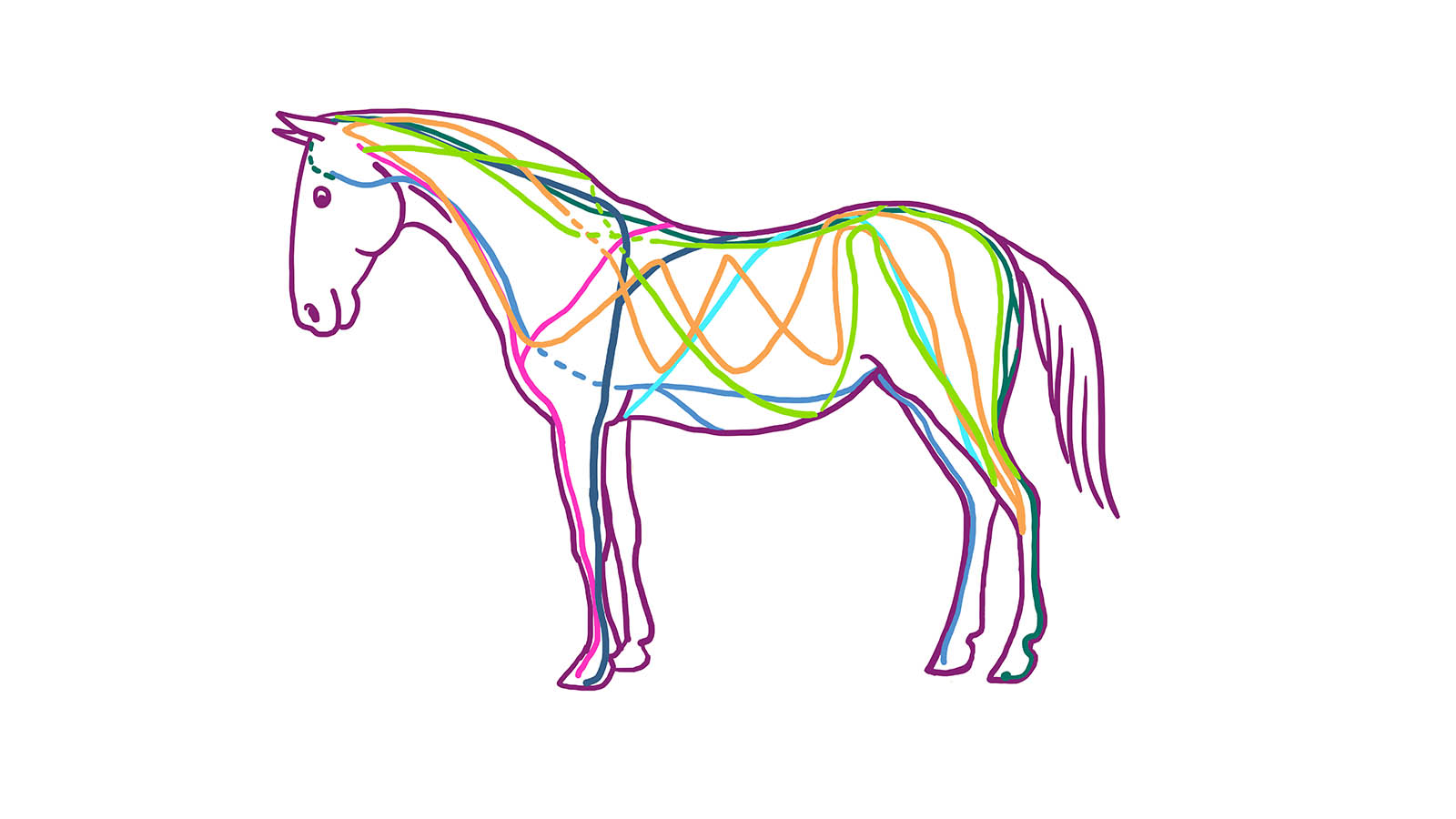
Through autopsy she found that the horse has the same kind of chains and networks of connective tissue through the body, as found in humans by Tom Myers.
- ArticleFascia Expert: “An explosion of new research in the last 10 years”
In 2015 veterinary Vibeke S Elbrønd published the first report on Fascia and horses. To make that happen she had to learn all there was regarding fascia, she had to become a fasci…
- ArticleFascia: New research changes the way we look at pain
From Newton, to Einstein, to the new wildfire of Fascia Research. How do we understand things from a different perspective?
- ArticleFrequently Asked Questions about Fascia
90 questions and answers — written by Camilla Ranje Nordin
- Ep. 01616. Deanna Hansen: Fascia decompression and the power to heal
The episode was first published on The Fascia Guide YouTube channel on February 5, 2025. In this inspiring episode, we meet Deanna Hansen — founder of Block Therapy™ and a pioneer…
- Ep. 00101. Why Fascia?
The first episode of the English podcast “The Fascia Guide”. The Fascia Guide is a podcast about the living body, about new research and a new perspective on health, pain and what…