


Anatomy Trains by Tom Myers helps us understand functions of movement
Tom Myers is perhaps best known for his book Anatomy Trains, where he describes the Myofascial lines which help us understand movement and functions of the body
- 01Roll a golf ball under each foot for 1–2 minutes to release the superficial back line
- 02Bend forward before and after to measure your range — expect at least 5 cm more reach
- 03Stop viewing the body as separate muscles and bones — fascia connects everything as one network
- 04The superficial back line runs head to foot and keeps the body upright out of fetal position
- 05Anatomy Trains divides fascia into lines for study, but all lines merge into a single continuous whole
Tom Myers has studied Fascia since the 70s and has also summarized other researchers’ studies on the Fascia.
What Myers is perhaps best known for is the power transmission lines, which he describes in his book Anatomy Trains. These can be a good basis for greater understanding of the Fascia’s functions. While all of these lines merge into each other and the entire Fascia acts as a whole and a network without beginning or end, it may be useful to divide them into these different parts and study their various functions.
These Fascia lines are not standalone own constellations, but part of a greater whole. The lines enclose muscles, organs, bones and cells. Myers describes it quite well when he says that we should stop seeing the body parts of different muscles, bones, organs, etc. It is more of a body stocking with a lot of different compartments. Learn more about these Fascia lines here.
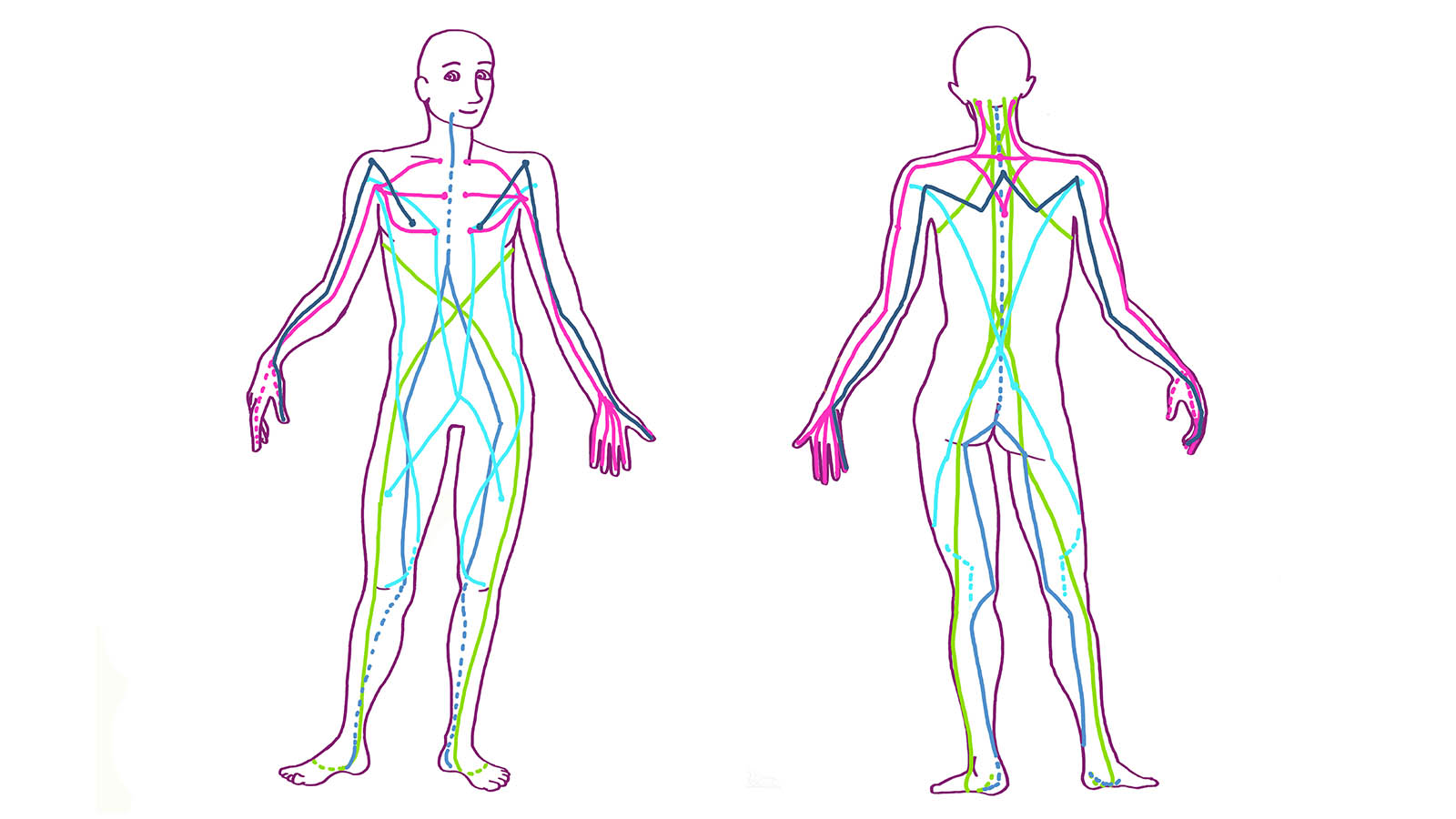
TIP: How you can “treat” the superficial dorsal line yourself
An example of such a line is the superficial dorsal line (superficial backline) that goes from the head down to the foot. The superficial back line prevents fetal position and keeps the body upright and stretched.
A very simple way to examine the superficial back line’s function, and thereby understanding how the body is composed, is called “exercise ball“.
- 1.Stand up with your legs straight and bend forward. The goal is for your fingers to reach the ground, but not everyone can reach. Anyway. Note how far down you come.
- 2.Take a golf ball, a tennis ball or something similar and roll it (with pressure) for about 1-2 minutes under each foot.
- 3.Repeat step 1 and note how far down you will reach now. You should come at least 5cm further down. Otherwise, repeat step 2 and try again.
What Myers is perhaps best known for is the power transmission lines, which he describes in his book Anatomy Trains.
- ArticleThe mysterious world under the skin – German Fascia Documentary from 2018
Get a deeper introduction to new Fascia Research with the 2018 German documentary “The mysterious world under the skin”.
- ArticleFascia Lines are the intersections of the body
The concept of Fascia Lines is a great way to understand how the body functions and how treatment can be optimized to increase mobility and functionality. The main principle is th…
- ArticleFascia does not only envelope the whole body, it turns the way we look at the body upside down
At the 2015 Fascia Research Congress in Washington DC, Tom Myers, the author of Anatomy Trains, gives a short introduction to Fascia and how new research changes the way we look a…
- Ep. 00404. Why is Fascia not mainstream?
Fascia research has sparked a wildfire of new insights that are challenging conventional belief about how the living body works. In the last 15-20 years thousands of high quality…
- Ep. 01212. How seeing the living body changes everything we thought we knew – with Jean-Claude Guimberteau, MD
The episode was first published on the Swedish podcast Fasciaguiden on May 26, 2025. In this episode, we meet the French surgeon Jean-Claude Guimberteau, who has spent more than 3…